3 November 2023
I've unlearned treating life as a series of goals you check off, says Karel Kovy Kovář.
Karel Kovář is a Czech presenter, author and, above all, an influencer — or, as he himself likes to say, a “vlivník.” On social media he goes by the nickname Kovy, under which he also appears on his YouTube channel, where he is just a step away from reaching one million subscribers. You're a presenter, author, musician — I'm not afraid to say a major figure on the Czech YouTube scene — and always
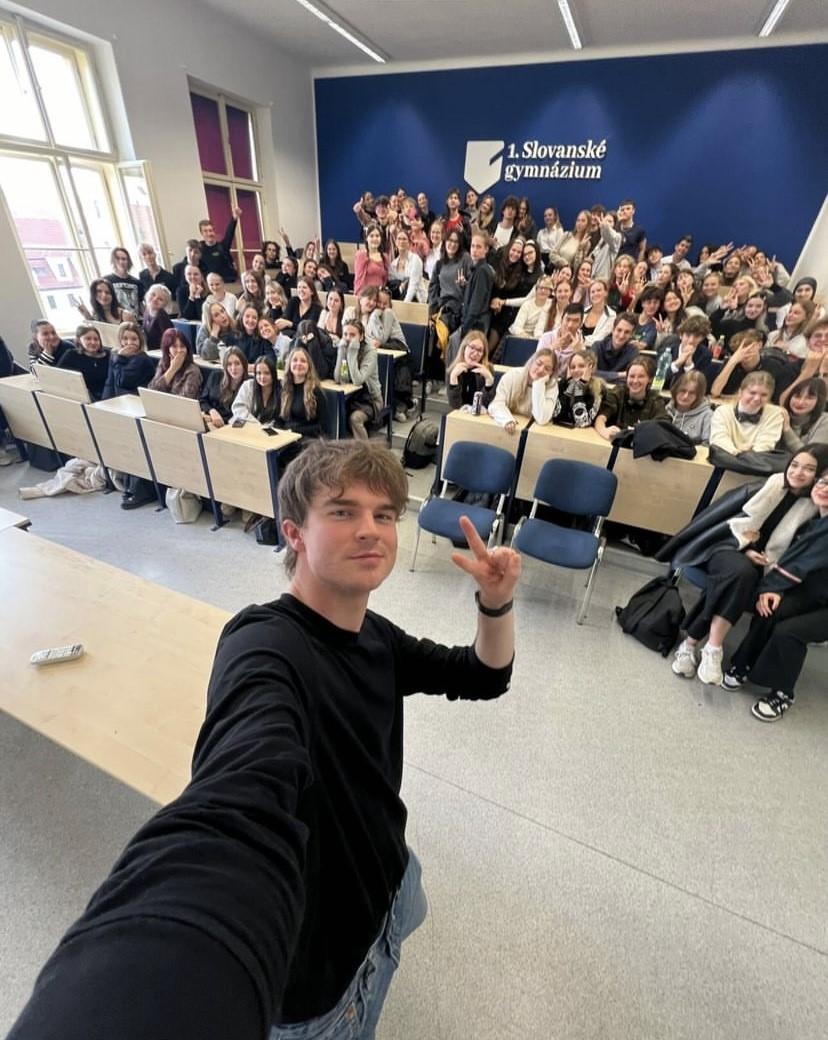
Karel Kovář is a Czech presenter, author and, above all, an influencer — or, as he himself likes to say, a “vlivník.” On social media he goes by the nickname Kovy, under which he also appears on his YouTube channel, where he is just a step away from reaching one million subscribers.
You're a presenter, author, musician — I'm not afraid to say a major figure on the Czech YouTube scene — and you always go by the nickname Kovy. So could we say that Kovy has become a brand?
It's funny, it started as a nickname in hockey, then it was the nickname I used when I set up my Minecraft account, then it became my nickname in videos, and now it's simply an inseparable part of my identity. A lot of people only know me as Kovy or address me as Kovy. If it's become a brand, in a way I suppose it has, because, as I said, a lot of people quickly picture my work when they hear it — or possibly the periodic table of elements, that can happen too — but yes, to some extent, I suppose it has.
So have you ever thought about registering Kovy as a trademark?
Not really, and I don't know if it would even be possible, since it's a common word. Probably, but I've never actually thought about it.
You're just a step away from reaching one million subscribers. That's a huge number. Does it also mean huge power, or is the impact of social media overrated?
I think we're all still figuring out just how significant the impact of social media really is. In some situations we probably tend to overrate it a bit, in others maybe not. But what we definitely overrate is that number, the subscriber count itself. A lot of those accounts are already inactive, a lot of them have been there for a long time, so it's more of a symbolic milestone than some defining life moment. But of course it also symbolizes for me the long road that led up to it. A lot of work, and also a lot of joy that came with it, and a lot of people who turn to my videos, whether because they want to brighten their day a bit or want to learn something new. And that, of course, is a big responsibility.
So you weren't waiting for that one million subscribers, waiting for it as if some new beginning would arrive?
Not anymore — I've unlearned the habit of treating life as a series of goals you tick off one by one. It's probably good to sense them somewhere in the background, but definitely not to be guided only by them. So I try to fixate on those numbers as little as possible, because they can sometimes be a good servant but a bad master. For me it's more of a nice cherry on top, and of course, back when I started, a completely unimaginable number in terms of subscribers — but not something I'd call a defining life moment. Probably not.
In your videos you very often cover politics and partly poke fun at it. So do you see politics as bizarre, or do you do it because people enjoy it?
Of course, some videos are specifically about me seeking out that political weirdness. Other videos are about me trying to describe a particular situation — what happened in Belarus, how Brexit played out, what's happening
around the Slovak elections, and I think in all these events, that weirdness simply can't be avoided, because it will always be there somewhere, and I think it's also good when we can lighten up more serious topics a little sometimes, because we're all only human and things don't always go well. Some politicians are so out of touch with reality that they don't even realize they're producing pretty bizarre output, while others do it deliberately to get attention. So in a way, I think politicians themselves are learning to work with the weirdness. Some make use of it and some try to avoid it, without realizing that it can sometimes come across that way anyway. Sometimes it's a deliberate goal to explore it as much as possible, other times it's more of a way to spice up an otherwise serious topic.
So do you have some limit of weirdness beyond which you wouldn't go?
I try not to play along too much with those who produce it on purpose, who deliberately make videos they know will be bizarre and go further, and which actually represent very toxic things, very divisive opinions, and spread them further precisely by creating appealing, slightly bizarre content. So I try to tell these things apart, and the best kind of weirdness is usually the kind that happens unintentionally.
Can a YouTuber's work fall into a routine?
It can. It's good to try to avoid that routine. What helps me with that is experimenting a lot, for example trying out new formats, approaches, and so on. But yes, it can happen. I think routine isn't exactly a friend of creativity.
On DVTV, after finishing your interview with the Dalai Lama, you said you weren't satisfied. So how do you work with that dissatisfaction?
I have that often. I'd almost say that with most interviews I do, I'm dissatisfied at the end, because I feel we didn't dig deep enough. But I'm learning to treat it as a kind of feedback. I tell myself, okay, next time I'll try to do it a bit differently, next time I'll try to focus in a slightly different way. An interview is an incredible chemistry between the interviewer and the interviewee. Whether you manage to get them to relax, what mood they're in, whether you get to those topics, whether they open up. It's always something you can't fully plan. And I'd almost say that on any given day of the week, the interview could turn out completely differently. Different on Monday than on Tuesday, different on Wednesday than on Thursday. So maybe it's good to approach them that way too — as simply a duo. Sometimes the interviewee doesn't want to open up, sometimes they don't give you much to work with, and other times it's exactly the opposite. I think a certain amount of dissatisfaction is part of the job for anyone who's hard on themselves. And I think it's important to be hard on yourself.
But it's not like you're dissatisfied after every video and say, “I should delete this.
No, it's mostly with those interviews that you just can't neatly plan and write out in advance. With a video you can plan everything nicely, write a script, edit it until you're happy with it, publish it, and it's great. But with an interview, it's really all about how it flows. It's a living organism — you have to listen, ask follow-up questions, try to venture into certain topics, often unplanned, and it always depends on how it turns out.
As one of your followers, I feel like I know quite a lot about you. But maybe that's not true at all. So I'd be curious whether you have some line you don't cross, and how much we, I should note, don't actually know about “Karel Kovář”?
I don't share my family, and for a long time I thought I wouldn't share my relationship either. But after a while I told myself that once it's something that's such an important part of my life, and at the same time a relationship that might automatically be seen through certain stereotypes — by some people perhaps as an inferior form of love — then it's something worth sharing and showing to people. But I think it's important to have set boundaries for what you share, and that it's important to keep some things just for yourself, that some things belong only to us. And sometimes we simply tend to think that if we don't share something, it's as if it never happened. That's not a particularly healthy way of thinking. So yes, there's a lot people don't know — probably nothing essential — but that's because I've chosen not to share it, and fortunately we all have the right to that. So yes, definitely, I have boundaries in place.
We're in the center of Prague, so which place around here is your favorite?
I'll have to think for a moment. I have to say that the places I love in the center have changed a lot, because I set up my studio here in the center back during covid. The center looked quite different than it does now, so I've reconsidered some of the places I used to like going to. I have to say that in general I love walking through the center, and I love old Prague. I really enjoy finding out what Prague looked like before the slum clearance, and how Prague changed — what was torn down, what the area around our office looked like before the Municipal House was even there. What was there and what wasn't. I love these transformations over time. I've loved Prague since I was a kid, and I'm very glad I get to spend so much time in the center, because I find it magical. But if I had to pick out just one place?
So which one would you recommend to us? Somewhere people don't know so well?
For example, I really love Týnská Street. It feels so magical and enchanting, with the tower rising above it. And what do a lot of people not know? I think, for example, the area around the Convent of St. Agnes. St. Agnes's Convent is beautiful, the gardens are lovely, and the streets around it — many of which survived the slum clearance in their original form — have some beautiful nooks. Stínadla, for instance, it's a bit like something out of Rychlé šípy.
I have one last question for you. In your channel description you say that you try to conjure up smiles. So who conjures up a smile on your face?
A lovely question to end on. My relationship, my family and friends, and dogs.
But you don't have a dog.?
I don't have a dog, but I meet plenty of dogs and I have to ask and get permission to pet a doggy. That always dramatically improves my mood. Then good humor, and seeing someone who's excellent at what they do and enjoys it and finds it fulfilling. That always makes me happy.
And do you enjoy what you do, and does it fulfill you?
Always, and that's why I do it.
Thank you for the interview.
Thank you too — by the way, great interview!
Natálie Č. III.A